
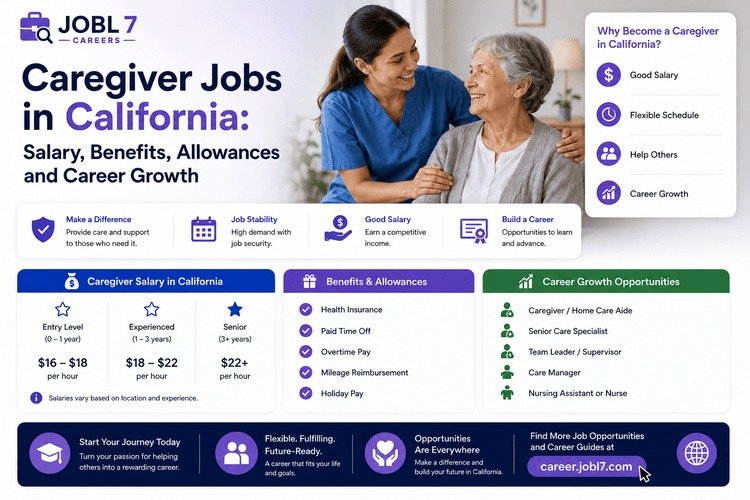
Caregiver jobs in California can offer a practical way to earn income while helping older adults, people with disabilities, and clients who need support with daily activities. However, pay and benefits can vary widely depending on the employer, county, job title, schedule, and type of care provided.
For someone considering caregiving as a career, the most important question is not simply the hourly wage. You should also consider overtime, paid sick leave, health benefits, mileage or other allowances, training requirements, scheduling, and opportunities to move into higher-paying healthcare roles.
How Much Do Caregivers Make in California?
There is no single caregiver salary for the entire state. Caregiver jobs can include personal care aides, home care workers, home health aides, and IHSS providers, and each position can have different compensation rules.
For comparison, the U.S. Bureau of Labor Statistics reported a $34,900 median annual wage for home health and personal care aides nationwide in May 2024, equal to about $16.78 per hour.
Actual California job postings can be higher. For example, recent California listings have advertised caregiver positions around $18–$25 per hour, while some specialized home health aide positions have advertised substantially higher rates.
California’s statewide minimum wage is $16.90 per hour in 2026, although certain healthcare workers and some local jurisdictions have higher minimum rates.
Example Caregiver Earnings
Schedule Hourly Rate Example Approx. Gross Weekly Income* Approx. Gross Monthly Income*
Part-time $18/hour $360 $1,560
Regular part-time $20/hour $600 $2,600
Full-time $22/hour $880 $3,813
Higher-paid position $25/hour $1,000 $4,333
*Examples assume 20 hours, 30 hours, or 40 hours per week as applicable and do not include taxes, overtime, bonuses, or unpaid time.
These are illustrative calculations, not guaranteed salaries. Your actual income depends on the position, hours, location, overtime, and employment arrangement.
What Benefits Can California Caregivers Receive?
Benefits depend heavily on whether you work for a private home-care agency, healthcare organization, assisted-living employer, or a public program.
Potential benefits may include:
Paid sick leave
Health insurance
Dental and vision insurance
Retirement plans
Paid training
Overtime pay when applicable
Flexible scheduling
Paid time off
Employee assistance programs
Bonuses or hiring incentives
Mileage reimbursement or travel-related compensation in some jobs
Not every caregiver receives all of these benefits. Always check the individual job offer before assuming a benefit is included.
For IHSS providers specifically, California provides a paid sick-leave program. For fiscal year 2026/27, eligible IHSS providers receive 40 hours of annual paid sick leave, subject to the program’s eligibility and usage requirements.
Caregiver Allowances and Extra Income
The word “allowance” can mean different things depending on the employer.
Some caregiver positions may provide additional compensation for specific circumstances, such as:
Mileage or travel reimbursement
Overnight or live-in arrangements
Overtime
Weekend or holiday shifts
Certain specialized assignments
Bonuses
Shift differentials
Paid training
However, these payments are not universal. A caregiver should ask whether an advertised rate includes bonuses, whether travel time is paid, and which expenses are reimbursed.
California’s IHSS wage structure also varies by county. The California Department of Social Services publishes county-specific IHSS provider wage information rather than one statewide provider wage.
What Does a California Caregiver Do?
Caregiver responsibilities depend on the position and the client’s needs.
Common duties can include:
Helping with bathing and dressing
Preparing meals
Light housekeeping
Laundry
Grocery shopping
Transportation assistance
Companionship
Helping clients maintain daily routines
Supporting mobility
Observing changes in a client’s condition
Home health aides may have additional responsibilities under appropriate supervision and state requirements. BLS distinguishes personal care services from certain health-related duties performed by home health aides.
How to Become a Caregiver in California
Many entry-level caregiver positions do not require a college degree. BLS reports that home health and personal care aides typically need a high school diploma or equivalent, although some positions do not require it, and short-term training is common.
A practical path is to:
Look for caregiver, personal care aide, or home care positions.
Review the employer’s education and background requirements.
Complete required training or screening.
Learn basic caregiving and safety procedures.
Build experience with clients.
Consider additional certifications when they can improve your career options.
Requirements can be different for home health agencies, facilities, and specific healthcare positions, so applicants should check the requirements for the exact job.
Is Caregiving a Good Career in California?
Caregiving can provide an entry point into the broader healthcare field without requiring a four-year college degree.
The career outlook is also strong nationally. BLS projects employment for home health and personal care aides to grow 17% from 2024 to 2034, much faster than the average for all occupations. The agency projects about 765,800 openings per year on average during that period.
Over time, experienced caregivers may explore opportunities such as home health aide work, nursing assistant roles, medical support positions, or further healthcare education.
How to Increase Your Caregiver Income
Higher earnings are not always about working more hours.
You can improve your earning potential by:
Comparing employers instead of accepting the first offer.
Looking at total compensation, not only hourly pay.
Considering weekend or evening shifts when differentials are available.
Developing specialized caregiving skills.
Keeping a record of hours and compensation.
Asking about overtime and paid training.
Comparing benefits between full-time and part-time positions.
Building experience that can support advancement into other healthcare careers.
For this reason, a $21-per-hour position with useful benefits may sometimes be more valuable than a $23-per-hour position with fewer benefits.
Frequently Asked Questions
How much do caregivers make in California?
Pay varies by job and location. Recent California job listings show caregiver positions advertised around $18–$25 per hour, while specialized positions may advertise higher rates.
Do caregivers get benefits in California?
Some employers provide benefits such as health insurance, paid sick leave, retirement plans, paid training, overtime, or bonuses. Benefits vary by employer and employment type.
Do California caregivers get paid sick leave?
Eligible IHSS providers can receive paid sick leave. For fiscal year 2026/27, the annual IHSS paid sick-leave amount is 40 hours, subject to program requirements.
Can caregiving become a long-term career?
Yes. Caregiving can provide experience that may help workers move toward other healthcare-support or nursing-related careers. The right path depends on education, training, experience, and the requirements of the next position.
Is caregiving a good job for someone without a college degree?
It can be. Many home health and personal care aide positions do not require a four-year degree, and some employers provide short-term training.