
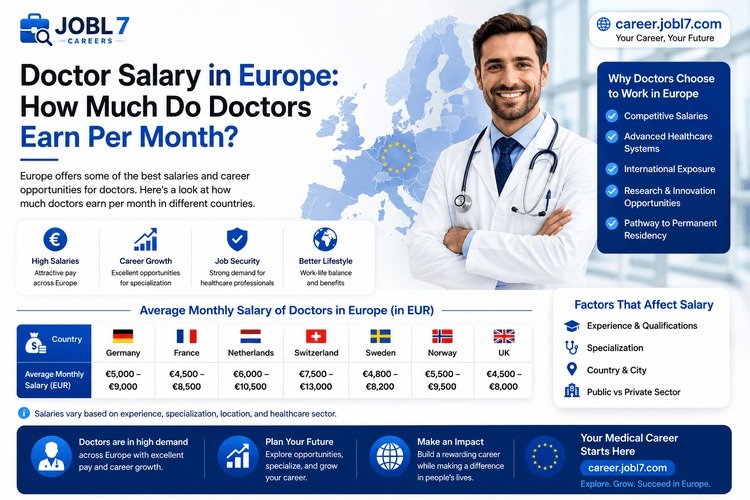
Becoming a doctor in Europe can offer strong earning potential, but salaries are not the same across countries. A physician’s income can change significantly depending on the country, specialty, experience, employment type, and whether the doctor works in the public or private sector.
The monthly salary also does not tell the whole story. Taxes, social contributions, working hours, cost of living, and professional licensing can affect how attractive a medical career really is. Therefore, anyone comparing doctor jobs in Europe should look at both income and the costs and requirements involved.
Understand How Doctor Salaries Work in Europe
Doctors in Europe generally do not have one standard salary. Income can come from employment in hospitals or clinics, private practice, additional work, and other forms of professional remuneration.
The OECD’s latest data shows that specialist doctors generally earn substantially more than the average worker in the countries measured. Salaried specialists typically earn between two and five times the average national wage, while self-employed specialists often earn around three to five times the average wage.
Doctor earnings can vary based on:
Country
Medical specialty
Years of experience
Salaried or self-employed status
Public or private employment
Working hours
On-call and overtime work
Local healthcare system
Taxes and social contributions
Cost of living
Because of these differences, an advertised annual salary should not automatically be treated as take-home income.
Estimated Doctor Earnings by Career Level
There is no single European monthly salary. However, official OECD data gives useful benchmarks for comparing physician remuneration.
The following table converts selected annual OECD figures into approximate monthly gross amounts. These are not guaranteed salaries and should not be interpreted as job offers.
Doctor Category Approximate Annual Gross Remuneration Approximate Monthly Amount
Salaried specialist in a lower-paying OECD market $65,000–$100,000 $5,400–$8,300
Salaried specialist in a higher-paying market $150,000–$250,000+ $12,500–$20,800+
Self-employed specialist in a high-paying market $250,000–$300,000+ $20,800–$25,000+
High-earning specialist markets $300,000+ $25,000+
The OECD’s 2025 comparison uses 2023 data or the nearest available year and adjusts international comparisons for purchasing power and inflation. For example, salaried specialists in Ireland averaged more than $250,000 on this adjusted basis, while self-employed specialists in Germany and Austria were among those earning close to or above $300,000.
These figures are useful for comparison, but they are not the same as money deposited into a doctor’s bank account.
Which European Countries Pay Doctors the Most?
Some European countries stand out for physician remuneration, although rankings depend on the type of doctor being compared.
Ireland had the highest reported remuneration for salaried specialists in the OECD’s latest comparison, with average income above $250,000 after the report’s purchasing-power adjustment. Germany and Austria were among the strongest markets for self-employed specialists, with average remuneration close to or above $300,000.
Germany also stands out for general practitioners. The OECD reports that self-employed GPs in Germany, Switzerland, and Austria had remuneration levels close to or above twice those of self-employed GPs in several other countries included in the comparison.
However, the highest salary does not automatically mean the best financial choice. Housing, taxes, insurance, working hours, and other living costs can change the real value of a doctor’s income.
Do Specialists Earn More Than General Practitioners?
In most countries, specialists earn more than general practitioners.
The OECD’s 2025 analysis found that specialists earned about 40% more than GPs on average across OECD countries and specialties. However, the difference varies considerably between countries and employment types.
Specialty also matters.
Among the specialist categories examined by the OECD, radiologists, anaesthesiologists, and ophthalmologists were generally among the higher earners. Paediatricians, meanwhile, often had remuneration closer to that of GPs.
For this reason, a person planning a medical career should compare both the country and specialty rather than looking only at the average doctor salary.
What Affects a Doctor’s Monthly Income?
Several factors can change how much a doctor earns.
Experience: Senior physicians may have greater earning potential than doctors who are still completing training.
Specialty: Some medical and surgical specialties have significantly higher remuneration than others.
Employment type: Salaried doctors and self-employed physicians can have very different income structures.
Location: Physician pay varies across European healthcare systems.
Working hours: On-call work, overtime, and additional clinical duties can affect total remuneration.
Private practice: In some countries, private work can provide additional earning opportunities.
Taxes: Gross income can be substantially higher than take-home pay.
Cost of living: A high salary may have less purchasing power in an expensive city.
Therefore, comparing only the gross monthly number can produce a misleading picture.
What Does a Doctor Need to Work in Europe?
Salary is only one part of becoming a doctor in Europe.
Doctors trained in another country may need professional recognition, registration, language skills, and authorization to practise. Requirements depend on the country and the doctor’s qualifications.
Specialists may also face additional requirements for recognition of their specialty training. Therefore, an international medical graduate should research the rules of the specific country before planning a move.
Professional licensing can be especially important because a high advertised salary has little value if a doctor cannot legally practise in that healthcare system.
Compare Salary With Cost of Living
A doctor earning more money is not necessarily financially better off.
For example, two physicians might have similar gross salaries but very different housing costs, taxes, transportation expenses, and working hours.
When comparing European medical careers, consider:
Gross annual salary
Approximate monthly gross income
Taxes and social contributions
Housing costs
Health and professional expenses
Working hours
On-call requirements
Training requirements
Career progression
Purchasing power
The OECD specifically adjusts some international salary comparisons for purchasing power because simple currency conversion does not fully show differences between countries.
Can Being a Doctor in Europe Become a Long-Term Career?
Medicine can provide a long-term professional career, but salary should not be the only reason to choose it.
Training can take many years, and physicians may face demanding schedules, continuing education requirements, and significant responsibility for patients. At the same time, medicine offers opportunities across general practice, hospital medicine, surgery, and many other specialties.
Someone comparing countries should therefore look at the complete career picture.
A strong decision considers expected income, training time, licensing requirements, working conditions, specialty opportunities, taxes, and living costs rather than choosing a country based on salary alone.
Frequently Asked Questions
How much does a doctor earn per month in Europe?
There is no single monthly salary for doctors in Europe. OECD data shows substantial differences between countries, specialties, and employment types. Approximate monthly gross income can range from several thousand dollars to more than $20,000 or $25,000 in some high-remuneration specialist markets.
Which European country pays doctors the most?
It depends on the type of doctor. In the OECD’s latest comparison, Ireland had the highest reported remuneration for salaried specialists, while Germany and Austria were among the highest for self-employed specialists.
Do specialist doctors earn more than GPs?
Generally, yes. The OECD reports that specialists earn around 40% more than GPs on average across OECD countries and specialties, although the difference varies by country.
Which medical specialties earn the most?
The OECD’s latest comparison identifies radiologists, anaesthesiologists, and ophthalmologists among the higher-earning specialist categories on average. Exact differences depend on the country and employment model.
Can foreign doctors work in Europe?
Yes, foreign-trained doctors can work in European countries, but they generally need to meet the professional recognition, registration, language, and licensing requirements of the country where they want to practise.